What "Water Rights Included" Actually Means When You Buy Land in Goshen County
September 24, 2026
September 24, 2026
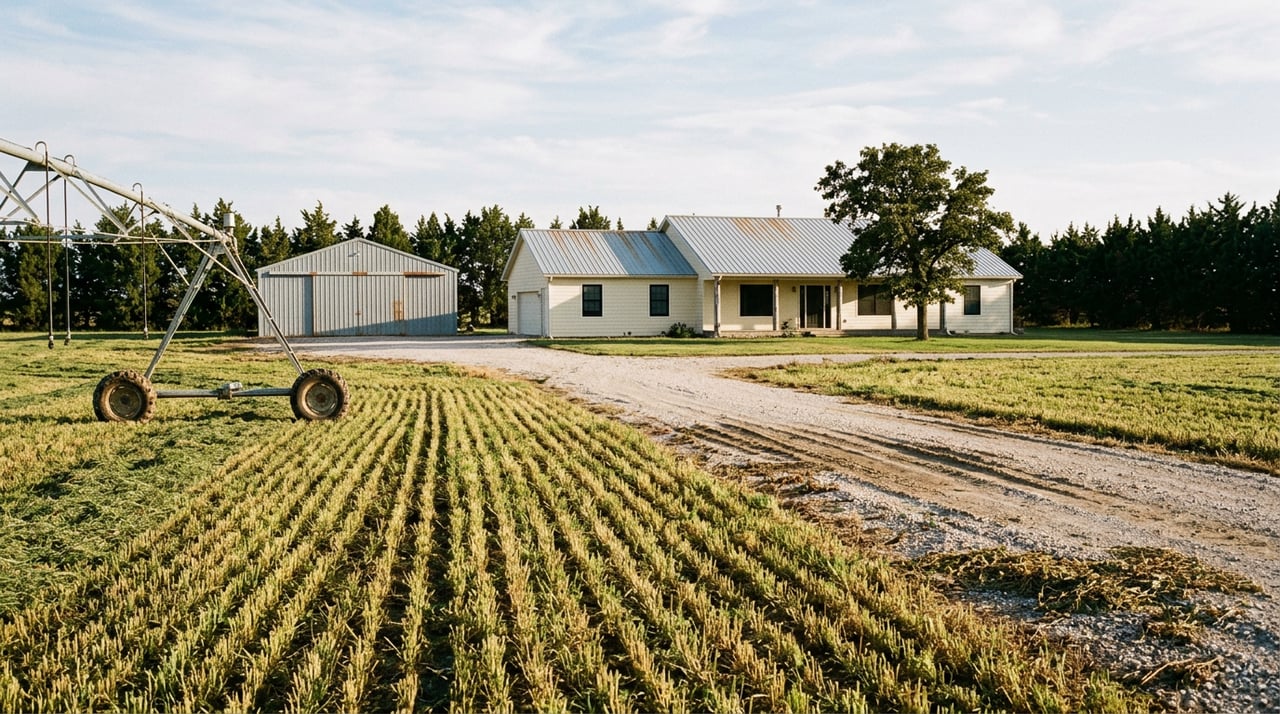
Scroll through farm and ranch listings around Torrington long enough and the same phrase starts to repeat itself like a standard amenity, tucked between a mention of center pivots and a note about two older but livable homes. It reads like one more line in a features list, the kind of detail a buyer might skim on the way to the photos of the barn.
That line is doing more work than anything else on the page. Land inside the Goshen Irrigation District doesn't just come with the ability to grow alfalfa or run pivots across a quarter section. It comes attached to a public water system that happens to be, this exact fall, in the middle of the largest rebuild in its 100-plus year history, a project still tangled in a federal lawsuit over how the repair contract was awarded.
If you're comparing irrigated ground in Goshen County right now, the water right isn't a bonus feature. It's the part of the purchase that determines what the land is actually worth to you five years from now, and it deserves more scrutiny than the barn.
The Goshen Irrigation District holds a supplemental water right on the Laramie River carrying a priority date of 1932, a fact addressed in the 1996 Wyoming Supreme Court case Goshen Irrigation District v. Wyoming State Board of Control over whether part of that right had been abandoned through non-use.
One recent Goshen County hay farm listing described a property totaling 285.64 acres, split between pivot and flood irrigation.
Before you compare price per acre across two listings, ask for the water-righted acreage, not just the total.
The Goshen Irrigation District's annual assessments fund the operation and maintenance of the canal system. Those assessments aren't fixed. They move based on what the district needs to spend, and this year the district needs to spend a lot.
In Cowboy State Daily, GID General Manager Kevin Strecker was direct about the mechanism in March, when a $100 million federal appropriation was announced for the district's tunnel rebuild. If the district had needed to take out a loan to cover what the federal award didn't reach, he said, it would have had to raise assessments on the landowners it serves to pay it back.
The infrastructure in question is the Fort Laramie Canal, built as part of the North Platte Project under the federal Reclamation Act, with its tunnels dating to 1917. The canal delivers water to more than 52,000 acres and roughly 400 farms in Goshen County, then carries water across the state line for the Gering-Fort Laramie Irrigation District in Nebraska.
On July 17, 2019, one of the canal's three tunnels collapsed, cutting off irrigation water to more than 100,000 acres of farmland across eastern Wyoming and the Nebraska panhandle for about six weeks. Temporary repairs restored most of the system's capacity, but the underlying tunnel, now more than a century old, needed a permanent rebuild.
That rebuild broke ground on October 28, 2025, with a groundbreaking ceremony at the Goshen Irrigation District office in Torrington. Preliminary work on Tunnel No. 2's inlet and outlet structures started that fall. Actual boring and replacement of the tunnel itself is scheduled to begin this fall, meaning it is either starting right now or about to. Tunnel No. 1 is next in line, with work planned through the fall of 2027 and full completion projected for spring 2028.
The price tag for the whole project is estimated at $150 million. The two irrigation districts had secured $64.5 million in state grants from Wyoming and Nebraska as of last fall. In March 2026, U.S. Rep. Harriet Hageman announced that $100 million of a $889 million Department of the Interior appropriation would go toward the Fort Laramie Tunnel Rehabilitation Project, calling it a top priority for the subcommittee she chairs. In a report by Cowboy State Daily, Gov. Mark Gordon called the award "an amazing opportunity for Wyoming."
None of that funding stack changes the underlying reality Strecker described. If costs run past what grants and federal money cover, the gap gets filled somewhere, and the most direct route is the annual assessment on the acres the canal serves.
The rebuild isn't proceeding without friction. In May 2026, a contractor called Drill Tech Drilling & Shoring filed a federal lawsuit against both the Goshen Irrigation District and the Gering-Fort Laramie Irrigation District, alleging the districts changed their agreement with construction manager Atkinson to allow it to self-perform the work rather than competitively bid it out, and that the districts violated public records laws when Drill Tech asked for documentation.
A federal judge ruled on the case in July 2026. He declined to pause the $150 million project, reasoning that stalling repairs further would risk real harm to the agricultural community that has already waited since 2019. At the same time, he found Drill Tech's claim that both districts violated public records laws was likely to succeed, even as he rejected the claim about secret contract awarding.
None of this threatens a typical land purchase inside the district. It does mean the infrastructure a buyer is relying on when they see "water rights included" sits inside an active, unresolved public dispute over cost and process, not a finished, stable system with a fixed annual bill.
Water-right assessments and property taxes both affect the cost of irrigated land. Wyoming taxes agricultural land based on productivity value rather than market value, assessed at 9.5% of that productivity figure. Goshen County's own published numbers for 2026 break out what that means per acre:
| Land Type | Approximate Annual Tax per Acre |
|---|---|
| Irrigated cropland | $16.29 |
| Dry cropland | $2.33 |
| Grazing land | $0.87 |
An average residential property in the county, valued around $260,000, carries an annual tax bill near $1,797 under the county's current mill levy of .072734. The irrigated rate is roughly seven times the dryland rate and nearly nineteen times the grazing rate, which tracks with the fact that irrigated ground produces more and, in a normal year, is worth more to farm. It also means an irrigated parcel carries a heavier fixed tax cost before a single GID assessment notice ever arrives.
If you're looking at irrigated ground anywhere in Goshen County, a few questions matter more than the listing photos:
A seller who farms the ground and pays the assessment every year should be able to answer all four without hesitation. If they can't, that's worth factoring into your offer.
Does the tunnel project make buying irrigated land in Goshen County riskier right now? Temporary repairs have kept the system functioning since 2019, and the current rebuild is meant to secure it for the long term. The risk is financial, not physical: assessments funding that rebuild could shift depending on how costs and the ongoing lawsuit resolve.
What if the land I'm looking at isn't inside the Goshen Irrigation District at all? Plenty of irrigated ground in the county relies on different infrastructure entirely, including private wells or other irrigation districts. The questions above still apply, just aimed at whichever system actually delivers the water.
Water rights are one of the most valuable things a piece of Goshen County land can carry, and one of the least understood by buyers coming from markets where water is simply something that comes out of a tap. Getting the allocation, the assessment history, and the district boundary right before you make an offer is the difference between buying a farm that pencils out and one that surprises you at tax time.
If you're evaluating irrigated or dryland property anywhere in Goshen County, the team at 307 Realty Professionals can walk through the specific district, allocation, and assessment questions tied to any parcel you're considering, and help you compare listings on the numbers that actually matter, not just the ones on the flyer.
This article is general information, not legal, tax or financial advice. Consult a qualified professional about your situation.
Stay up to date on the latest real estate trends.

With deep local knowledge and a commitment to your goals, we’re ready to help you move forward with clarity and confidence.